TraCE explains a video prediction with the trajectories that drove it. Pick an example: the overlaid chevrons are the top-ranked trajectory concepts, drawn on the regions of the clip that activate them.
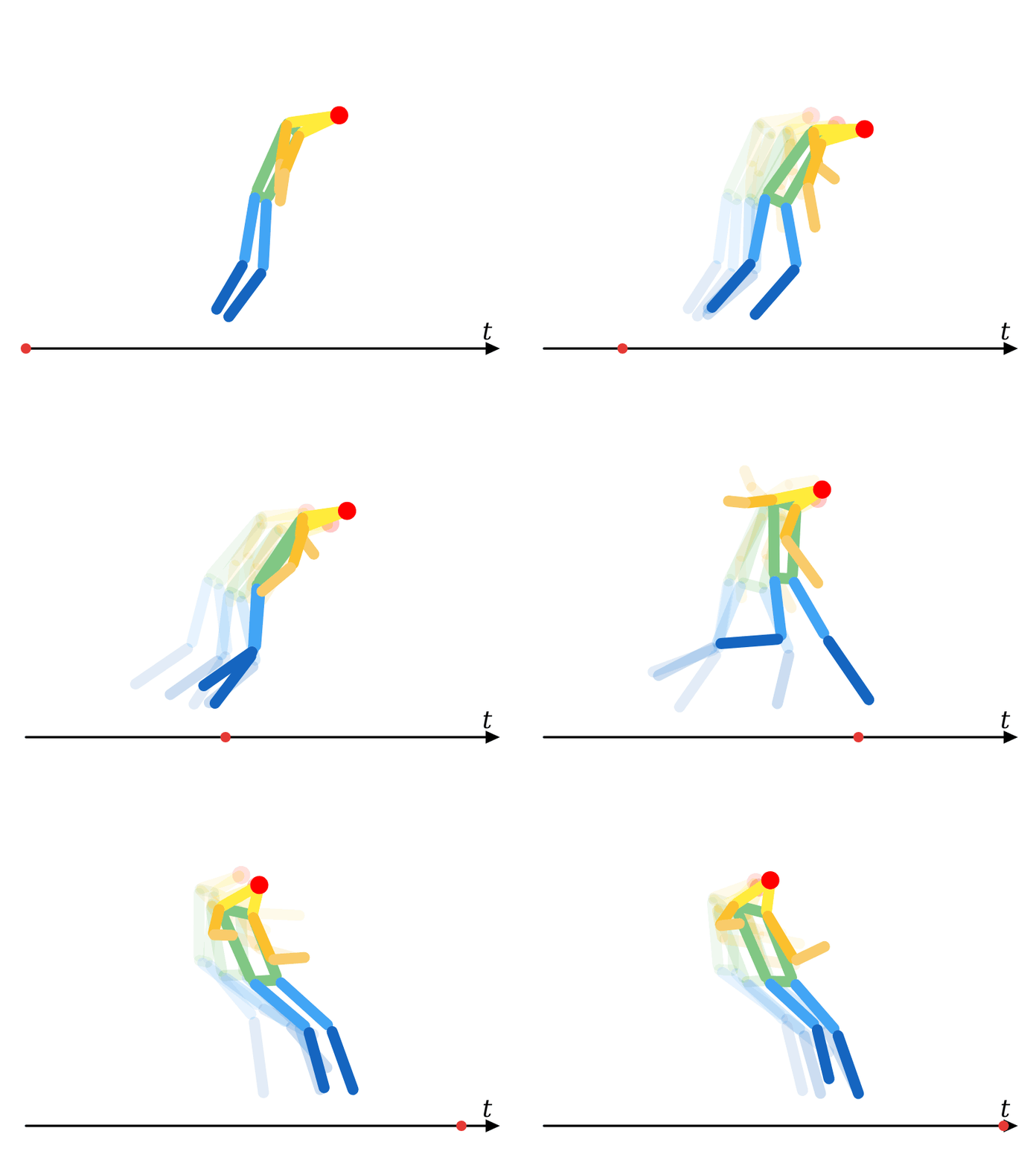
Multi-agent interaction. The two highest-contributing concepts correspond to the pushing motion of one person and the displacement of the other. A pose-based vocabulary would see only one person's joints.
Object-centric dynamics. The full human body is never in frame, yet the top concepts follow the two objects being brought together. There is no joint to attach this motion to; the trajectory is the concept.
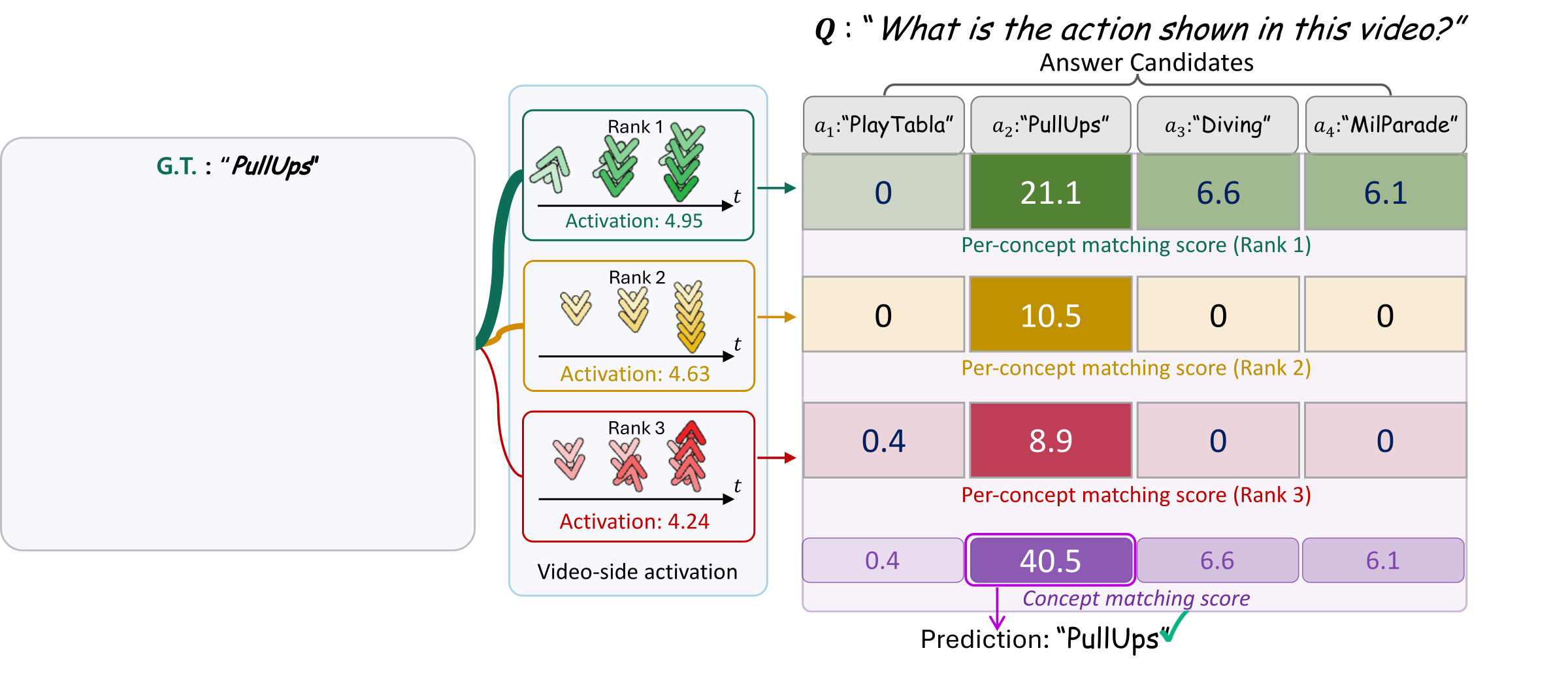
Concept matching explains a VQA answer. Rows are the top-3 video-side concepts, columns the answer candidates. PullUps scores highly on trajectory concepts that capture repeated vertical motion, so the prediction is explained by a structured match rather than a black-box score.
Demo video. For each input clip, the top contributing trajectory and object concepts are shown with their contributions, followed by the prediction.
Existing video explanations say that motion matters but not which motion. TraCE clusters optical-flow trajectories into Trajectory concepts and pairs them with Object and Scene concepts, so one typed interface explains both action recognition and VQA, at a cost of about one accuracy point.
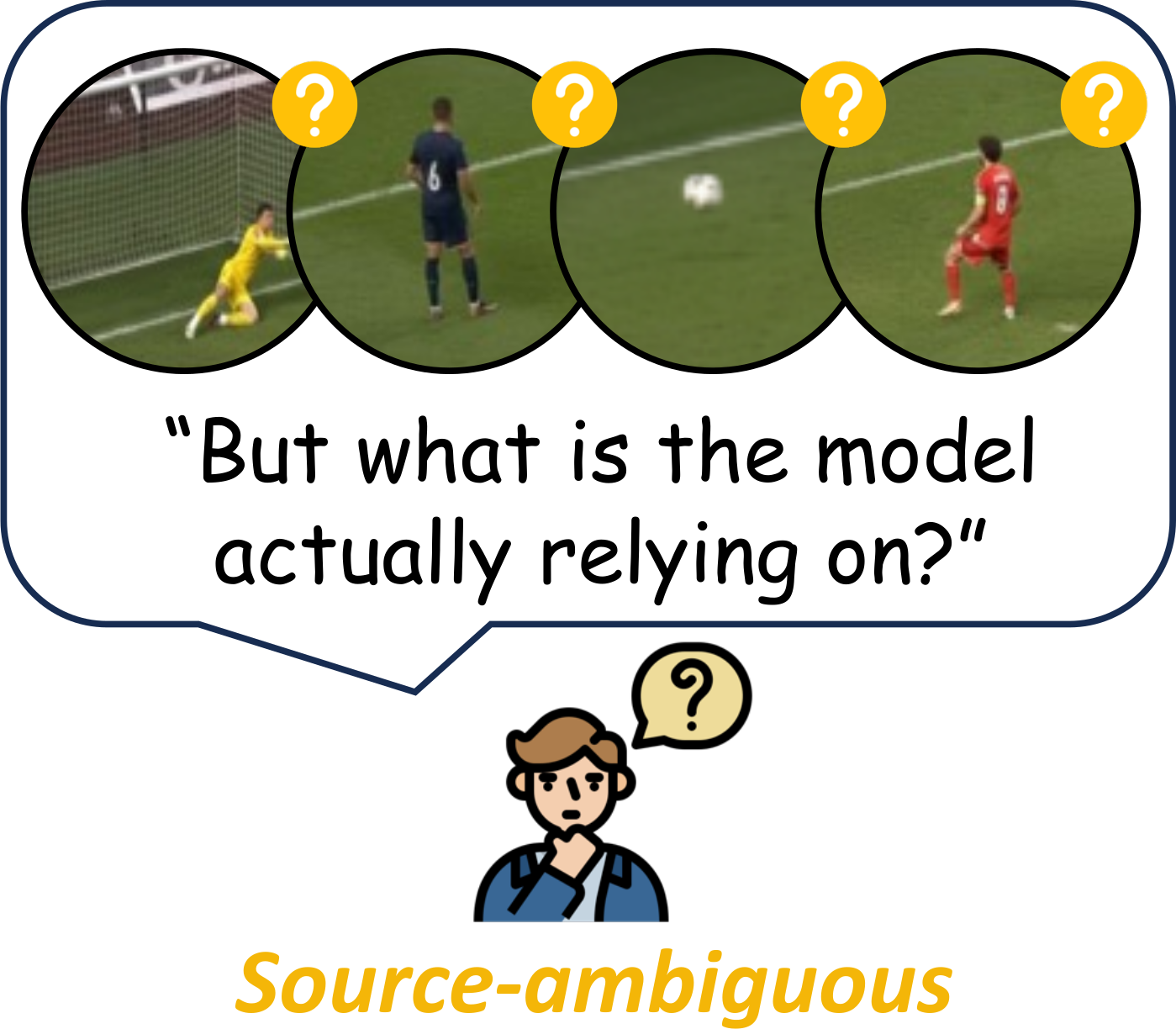
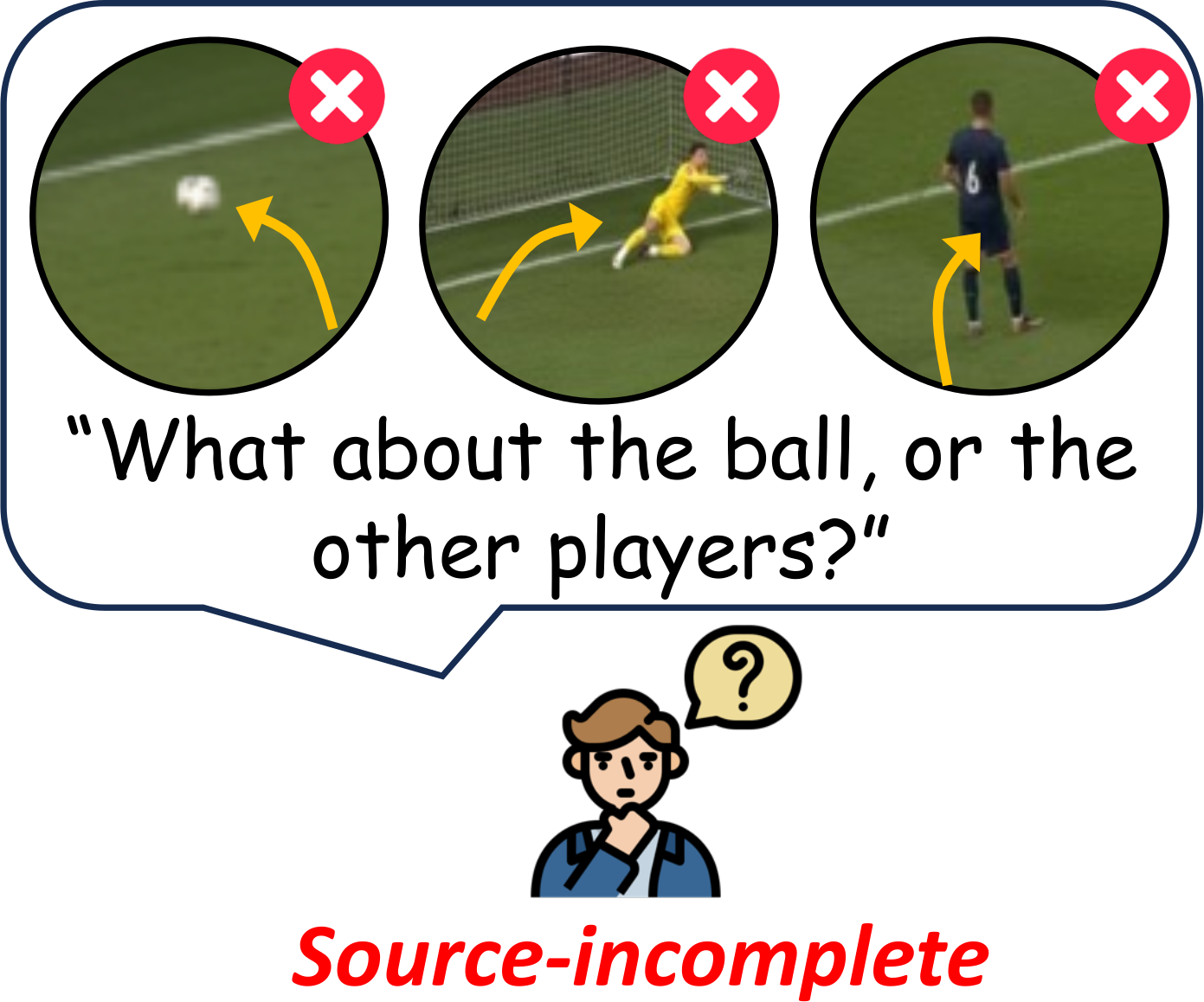
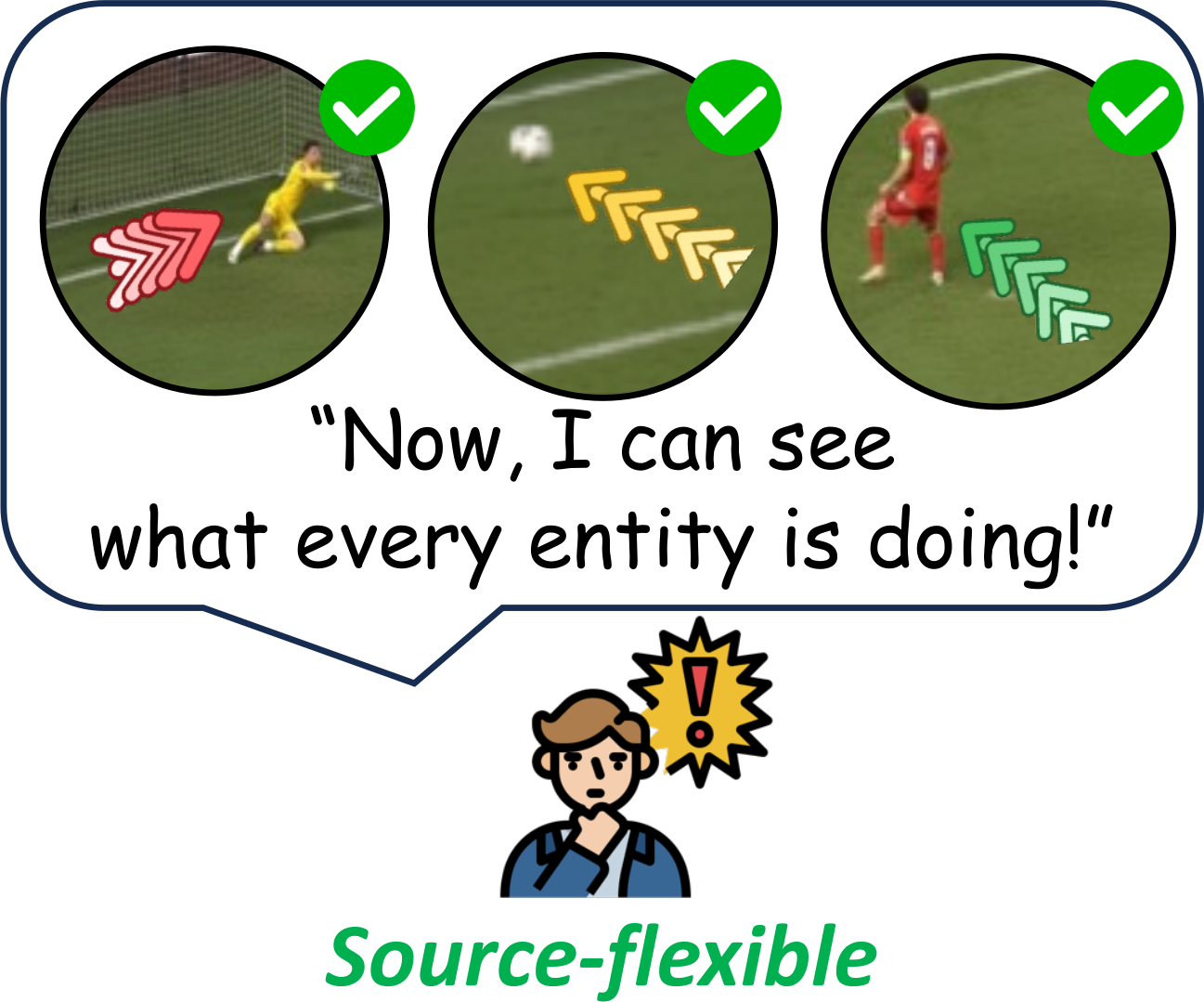
Video understanding models often rely on motion, but faithful explanations must reveal not only whether motion matters, but also which source of motion supports a prediction. We identify motion-source under-specification as a key limitation of existing video XAI: region-centric explanations are source-ambiguous, while concept-based explanations are source-incomplete when their motion vocabulary is restricted to single-person pose sequences. To bridge this gap, we propose TraCE—Trajectory-Aware Concepts for Explainable Video Understanding—a concept-based framework that elevates visual trajectories to first-class explanatory concepts. By clustering optical-flow trajectories, TraCE discovers source-flexible motion concepts that capture dynamic evidence from people, objects, and interactions, while object and scene concepts account for static context. TraCE applies the same typed trajectory/object/scene concept interface to both action recognition and video question answering (VQA), enabling concept-level explanations beyond a single task. We evaluate TraCE across six benchmarks: NTU RGB+D Mutual, Chiral SSv2, UCF-101, KTH, TOMATO, and STAR. Across five random seeds, TraCE provides trajectory-aware explanations of dynamic evidence with a modest 1.0-point average trade-off on action recognition and comparable VQA performance (a nominal 0.4-point average gain) relative to non-interpretable baselines. User studies, faithfulness analyses, temporal sensitivity tests, and concept-intervention results further show that TraCE produces interpretable, faithful, and practically useful explanations.
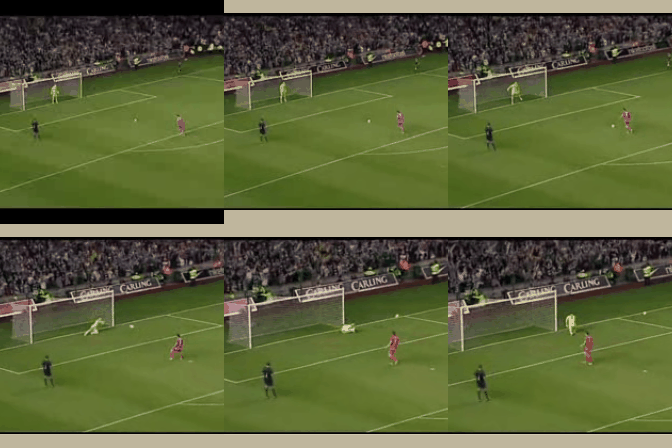
Motion in a video comes from actors, manipulated objects, and interactions among entities, each with different semantics. Same clip, same prediction, three ways of explaining it.


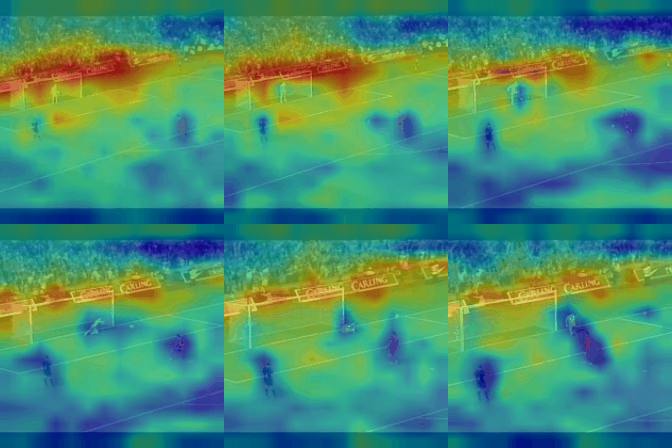
Region-centric heatmaps show where evidence is. The highlighted region mixes the kicker, the ball, and the static goal, so the viewer has to infer the motion themselves.

One person's body motion becomes explicit, but the vocabulary is defined over human joints. The ball's flight and the other players have no concept to land on.

Every moving entity gets its own concept: the goalkeeper's dive, the ball's flight, the kicker's run. Object and scene concepts cover the static context separately.
Eight steps, one diagram. Use the arrows (or ← →) to build the model up from a plain video classifier to a typed concept interface that explains both action recognition and video question answering.
A frozen video encoder turns a clip into a feature vector and a classifier turns that into a label. It works, but nothing in between has a meaning you can point at: you cannot ask which motion the decision relied on.
TraCE puts a concept layer between the features and the classifier. Each of its units stands for one concept, and the classifier is only allowed to see those units. The explanation now lives inside the model rather than in a post-hoc heatmap.
The layer is split into three typed groups. Trajectory concepts carry dynamic evidence, Object and Scene concepts carry static context. Keeping them separate is what lets TraCE say which source of evidence a prediction used. Where the trajectory concepts themselves come from is shown in the card below.
A clip flows through, concepts light up, and the sparse linear classifier sums them into a prediction. Because the classifier is linear, each concept's contribution is simply its activation times its weight. The three strongest here are a diving trajectory, the object “soccer ball”, and the scene “soccer field”: the same kind of explanation you saw in the viewer above.
Video question answering adds a second input. The question is paired with each candidate answer and encoded by a frozen text encoder, giving one text feature per candidate. The video side is left exactly as it was; only the classifier is set aside.
A text concept layer maps each candidate into the same trajectory, object, and scene concepts, in the same order, as the video side. The result is a relevance vector per candidate: which concepts that answer would need to be true. Trajectory concepts have no names, so this part is learned from answer supervision rather than from text similarity.
For each candidate, the video's activations and the answer's relevance are compared unit by unit. A concept counts only if the video shows it and the answer needs it, so most entries stay silent and a few light up: here a leftward trajectory and the player object for “Left”.
Only the strongest few matches within each concept group are summed, with a learned weight per group, into a compatibility score. The highest score is the answer, and the handful of concepts that produced it is the explanation. That is exactly the PullUps table in the viewer.

Six benchmarks, two tasks, five seeds. Same frozen backbone within each task: VideoMAE for action recognition, InternVideo2 for VQA.
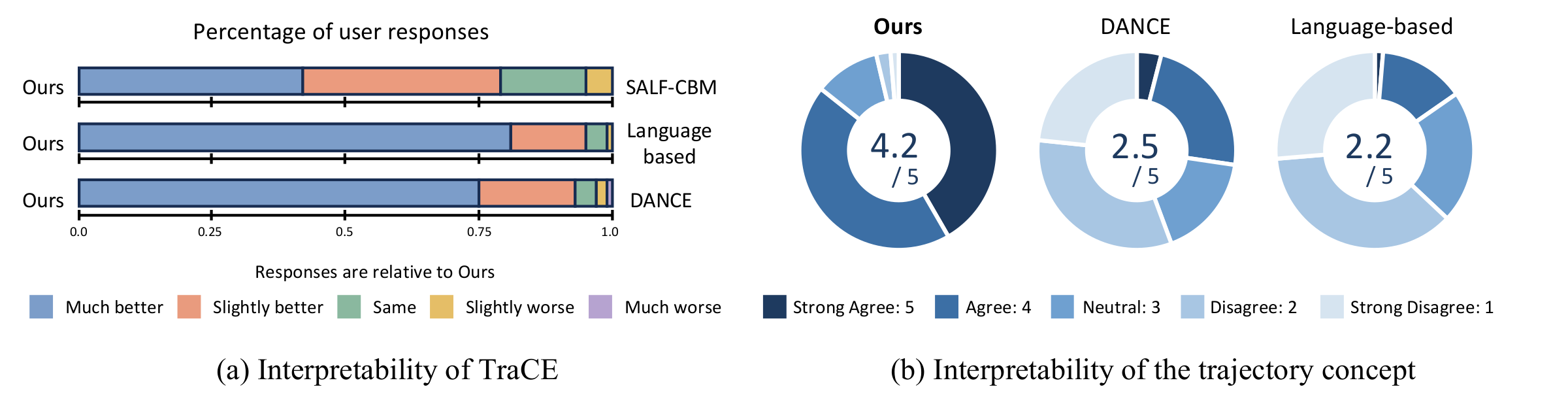
In pairwise comparisons, over 93% of responses prefer TraCE explanations to DANCE and a language-based CBM, and about 78% prefer them to SALF‑CBM. See the user study
−1.0 pt against the non-interpretable baseline, and the highest average among interpretable methods.
+0.4 pt, within seed variance, and the highest average among concept-based methods.
| Method | NTU RGB+D Mutual | Chiral SSv2 | UCF-101 | KTH | Avg. |
|---|---|---|---|---|---|
| Baseline w/o interpretability | 99.7±0.2 | 86.6±0.2 | 89.8±0.1 | 91.1±0.3 | 91.8 |
| LF-CBM w/ language concepts | 96.9±0.3 | 77.6±0.5 | 88.3±0.2 | 89.1±0.7 | 88.0 |
| DANCE | 97.1±0.3 | 81.7±0.3 | 89.0±0.2 | 91.3±0.4 | 89.8 |
| SALF-CBM | 99.7±0.0 | 80.4±0.4 | 87.5±0.2 | 87.9±0.4 | 88.9 |
| TraCE | 97.4±0.1 | 84.9±0.4 | 89.0±0.3 | 91.8±0.8 | 90.8 |
Top-1 accuracy (%), mean ± std over five seeds. Underline: best among interpretable methods. DANCE and SALF-CBM use pose-sequence and spatially‑aware language concepts respectively; neither defines a VQA answer-scoring mechanism.
| Method | NTU RGB+D Mutual | Chiral SSv2 | UCF-101 | TOMATO | STAR | Avg. |
|---|---|---|---|---|---|---|
| Baseline w/o interpretability | 97.4±0.1 | 82.6±0.2 | 99.8±0.0 | 35.9±2.2 | 54.5±0.4 | 74.0 |
| MM-CBM w/ language motion concepts | 97.6±0.1 | 82.0±0.4 | 99.7±0.1 | 31.7±3.6 | 56.5±0.5 | 73.5 |
| MM-CBM w/ pose-sequence concepts | 97.6±0.1 | 82.3±0.6 | 99.7±0.1 | 28.7±7.0 | 55.9±0.7 | 72.8 |
| SpLiCE adaptation | 53.0 | 57.3 | 86.7 | 22.4 | 49.2 | 53.7 |
| TraCE | 97.1±0.3 | 82.6±0.6 | 99.7±0.1 | 37.0±1.7 | 55.4±1.2 | 74.4 |
Answer accuracy (%), mean ± std over five seeds (SpLiCE: single run). Underline: best among concept-based methods. The two MM-CBM variants keep the same concept-space matching design as TraCE but swap in language-derived motion concepts (LF-CBM) or pose-sequence concepts (DANCE); SpLiCE is adapted to question-conditioned scoring. NTU, Chiral SSv2, and UCF-101 are multiple-choice reformulations of action labels; TOMATO and STAR are native VQA benchmarks. Differences among the top rows are within seed variance except on TOMATO.
Two studies on motion-focused subsets of NTU RGB+D Mutual and Chiral SSv2. (a) In pairwise comparisons, over 93% of responses prefer TraCE explanations to DANCE and a language-based CBM, and about 78% prefer TraCE to SALF-CBM. (b) Asked how well a concept matches the motion shared by its top-activating clips, participants rate trajectory concepts 4.2 / 5, versus 2.5 for pose-sequence and 2.2 for language-derived motion concepts. In a separate blinded study in the VQA setting (50 participants, 250 ratings per comparison, both models correct on every item), participants prefer TraCE explanations in 70.4% of comparisons against language-derived motion concepts and 85.6% against pose-sequence concepts.
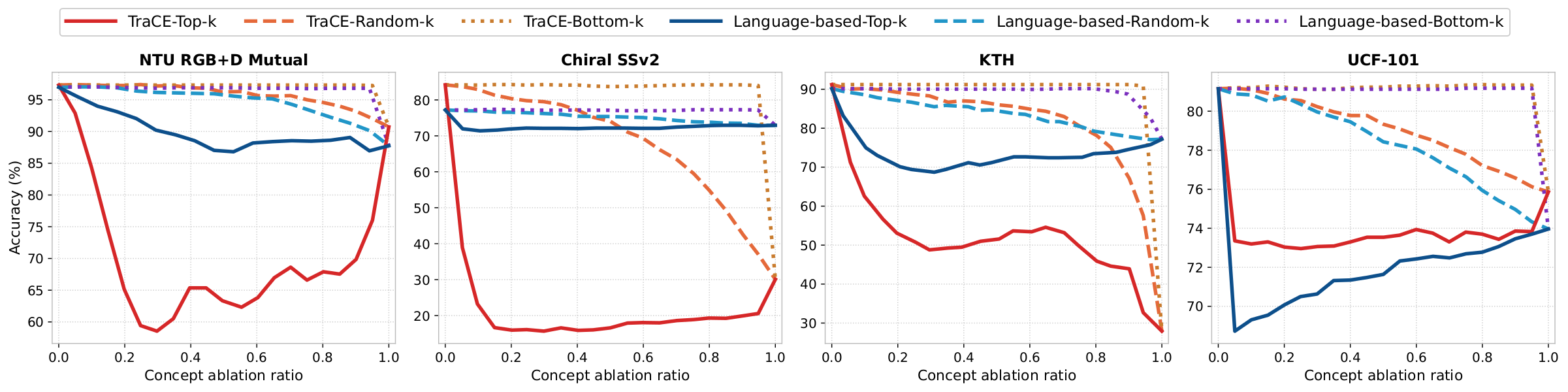
Removing the top-ranked trajectory concepts breaks predictions; removing random ones does not. The numbers below are the sanity checks behind that claim; full tables are in the paper.
Concept intervention curves. Accuracy as concepts are removed in Top-k, random, and Bottom-k order of contribution, for TraCE and a language-based CBM. The separation is weaker on UCF-101, where many classes are recognizable from static cues alone.
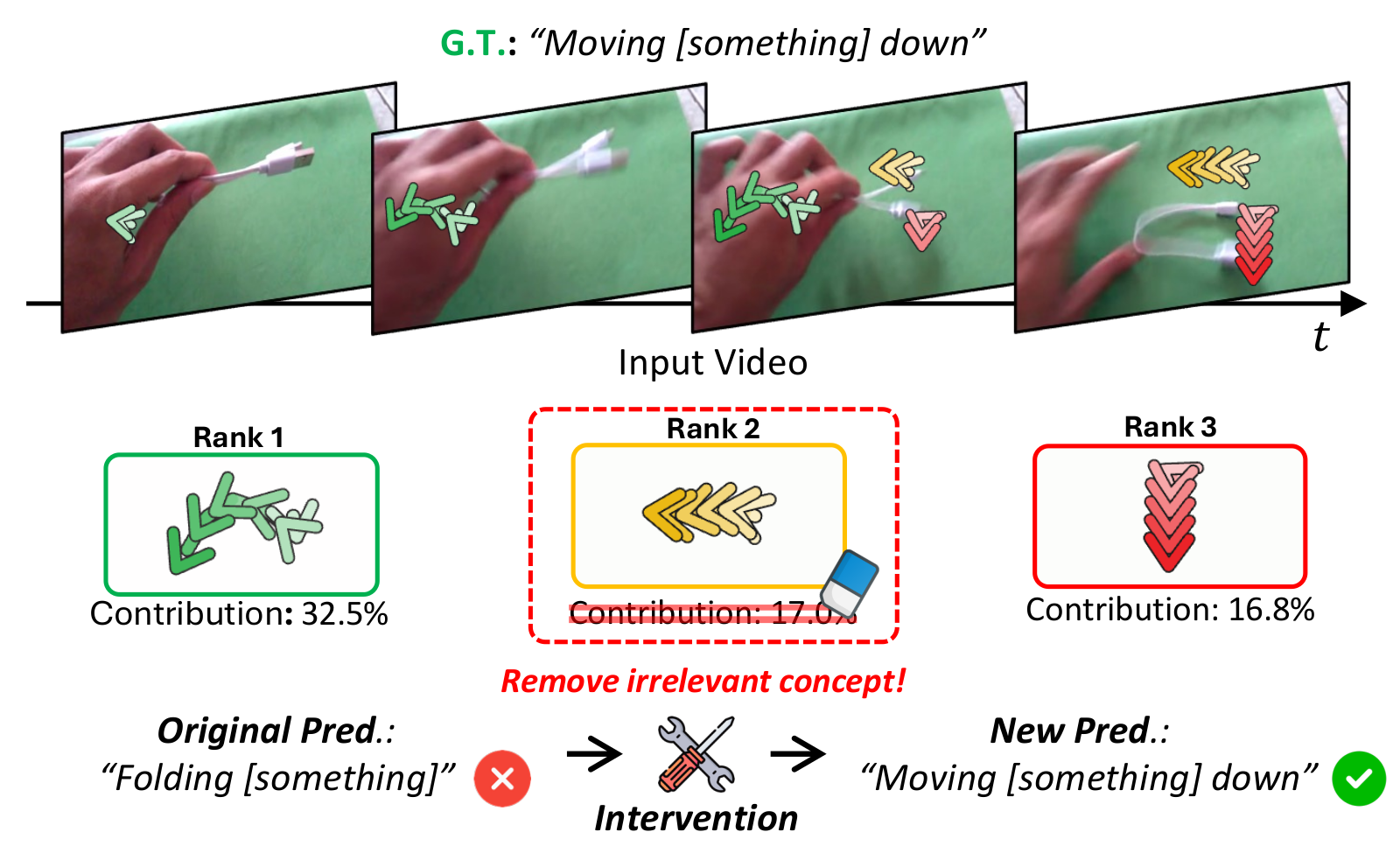
Explanations are actionable. The model misreads Moving [something] down as Folding [something] because of a leftward-motion concept. Deactivating that one concept corrects the prediction.
@inproceedings{lee2026trace,
title = {{TraCE}: Trajectory-Aware Concepts for Explainable Video Understanding},
author = {Lee, Wooil and Hong, Junpyo and Lee, Jongseo and
Oikarinen, Tuomas and Weng, Tsui-Wei and Choi, Jinwoo},
booktitle = {Advances in Neural Information Processing Systems (NeurIPS)},
year = {2026}
}